
If you’ve got a dead or unwanted car sitting in the driveway, you may already know you want to sell it. The next question is usually much simpler: how long will the process take, and when will I get paid?
The answer depends on the condition of the vehicle, how accessible it is, whether you need to compare offers and how quickly the required paperwork can be completed.
For many sellers, the actual process can be completed within a day once an offer has been accepted. In other cases, it may take a few days if you need to organise documents, compare several offers or arrange a more complicated vehicle pickup.
Here’s what the process can look like from the first quote through to vehicle removal.
The short answer
Selling a scrap car can take anywhere from a few hours to several days. If you already know which buyer you want to use, have the relevant information available and the vehicle is easy to access, a same-day pickup may be possible, depending on availability and location.
If you want to compare several offers first, or there are paperwork or access issues, the process can take longer.
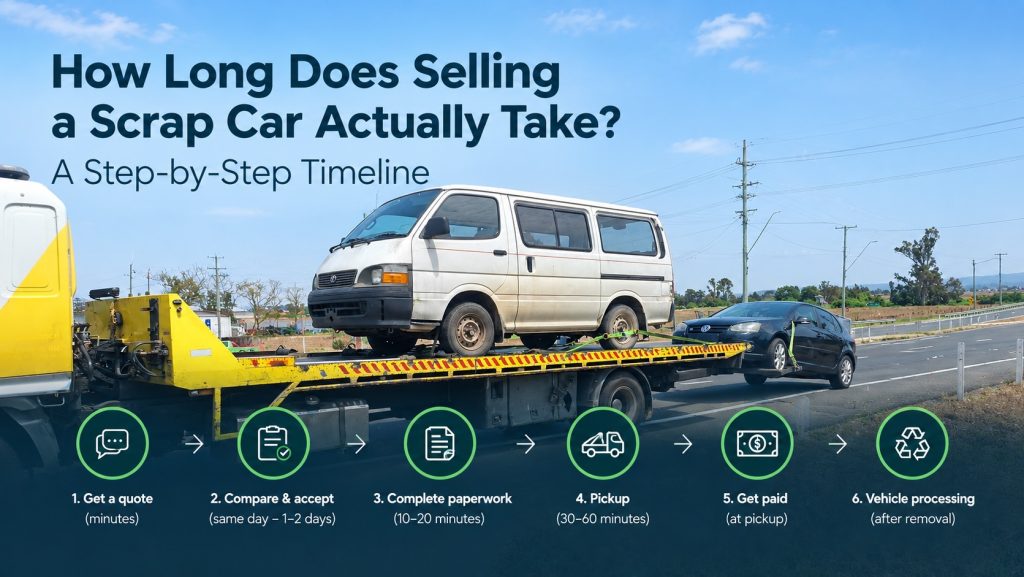
The timeline usually looks like this:
- Request a vehicle quote
- Compare and accept an offer
- Confirm the required paperwork
- Arrange vehicle pickup
- Complete payment and handover
- The vehicle is taken away for assessment and processing
Let’s look at each stage in more detail.
Step 1: Getting a quote — around 5–15 minutes
Getting an initial quote is usually one of the quickest parts of selling a scrap car. A vehicle buyer will generally want basic information such as the make, model, year, condition and whether the vehicle is running. It can also help to mention major issues such as accident damage, rust, missing parts or mechanical problems.
You don’t need to spend hours preparing the vehicle before requesting a quote. Giving accurate information about its condition can help the buyer provide a more realistic estimate.
You may be able to request a quote by phone, online or through another enquiry method offered by the buyer.
Typical time: 5–15 minutes.
Step 2: Comparing offers and accepting one — immediate to 1–2 days
This part is largely up to you. If you’re happy with the first offer and the buyer can arrange a suitable pickup time, you may be able to move straight to the next stage.
If you want to compare two or three offers, allow additional time for quotes and responses. Taking a little time to compare offers can be worthwhile, particularly if your vehicle has significant salvage value or reusable components.
Before accepting an offer, make sure you understand:
- The amount being offered
- How the vehicle will be collected
- Whether vehicle removal is included
- How and when payment will be made
- What paperwork you need to provide
Once you’ve accepted an offer, the pickup can be arranged according to the buyer’s availability and your location.
Typical time: Same day to 1–2 days.
Step 3: Sorting out the paperwork — around 10–20 minutes, depending on your situation
Paperwork doesn’t usually take long, but missing information can delay the process. The documents or information required can vary depending on the vehicle, its registration status, your state or territory and the buyer’s requirements.
It’s a good idea to have relevant identification and vehicle ownership or registration information available before arranging collection. If you’ve lost documents, ask the buyer what alternative evidence they can accept rather than assuming a particular document will be sufficient.
If the vehicle is registered, you should also make sure you complete the required registration transfer or disposal steps for your state or territory.
For example, Queensland Government says eligible sellers can transfer Queensland registration online, with the seller completing their part before the buyer finalises the transfer. Queensland also states that registration should be transferred within 14 days of the sale.
For current Queensland requirements, check the official Queensland Government vehicle registration transfer information.
For vehicles registered in other states or territories, check the relevant government authority because the process can differ.
Typical time: Around 10–20 minutes when everything is ready.
Step 4: Vehicle pickup — around 30–60 minutes
Once the pickup has been arranged, the physical handover is generally straightforward. The removal team arrives at the agreed location and checks the vehicle against the information provided. If everything matches the agreed condition, the required paperwork can be completed and the vehicle can be loaded for removal.
How long this takes depends on where the vehicle is parked and whether it can be accessed easily. A car sitting in an open driveway is generally simpler to collect than one behind another vehicle, inside a narrow accessway or in an area where a tow truck has limited room to operate.
If the vehicle doesn’t run, let the buyer know before pickup. This allows the appropriate equipment to be arranged.
For more information about selling a vehicle that may require specialised removal, see Metro Salvage’s guide to selling a salvage vehicle.
Typical time: Around 30–60 minutes, although difficult access can take longer.
Step 5: Payment and vehicle handover
Payment arrangements depend on the buyer and the agreement reached when the vehicle is sold. Before pickup, confirm how payment will be made and when you should expect to receive it. If a buyer offers immediate payment at the time of collection, the payment process can generally be completed as part of the handover.
The important thing is to make sure the payment terms are clear before the vehicle leaves your property.
Once the vehicle has been collected and the agreed payment has been completed, your part of the selling process is essentially finished.
Step 6: What happens to the car after removal?
Once it’s off your property, it goes through the standard car salvage process but that part is on us, not you. Your timeline ends at pickup.
So, how long does selling a scrap car really take?
There isn’t one fixed timeframe for every vehicle. A realistic guide looks like this:
| Situation | Typical timeframe |
|---|---|
| You already know who you’re selling to and the vehicle is easy to access | Same day may be possible |
| You want to compare several offers | 1–2 days or longer |
| Additional paperwork needs to be arranged | May add extra time |
| The vehicle is difficult to access | Additional planning may be required |
| The vehicle is non-running or requires special towing equipment | Pickup timing depends on equipment and availability |
These are general timeframes rather than guarantees. Your location, vehicle condition, access and buyer availability can all affect the final schedule.
What can delay the sale?
In many cases, the biggest delays aren’t caused by the actual sale. They’re caused by practical issues that could have been sorted out beforehand.
Missing paperwork
If you don’t have the relevant registration or ownership information, contact the buyer before booking the pickup and ask what documentation is required.
Difficult vehicle access
Tell the buyer if the car is behind another vehicle, inside a narrow driveway, in a basement car park or somewhere a tow truck may have difficulty accessing.
Comparing too many offers
Comparing offers can help you make a better decision, but waiting several days for multiple quotes will naturally extend the overall timeline.
Registration hasn’t been dealt with
If the vehicle is registered, make sure you understand the registration transfer or disposal requirements that apply in your state or territory. In Queensland, sellers have specific responsibilities when transferring a registered vehicle, including completing the relevant transfer process.
The vehicle’s condition wasn’t accurately described
If a vehicle’s condition is significantly different from what was described when the quote was provided, the final assessment may take longer and the offer may need to be reconsidered.
Being upfront about major damage, missing components and whether the car runs can help avoid unnecessary delays.
Can you really sell a scrap car in one day?
Yes, it can be possible. If you have the necessary information ready, accept an offer promptly, the vehicle is accessible and the buyer has pickup availability, the process can potentially be completed within the same day.
However, same-day service should be treated as an option rather than a guarantee. Pickup times depend on factors such as location, vehicle condition, access and availability.
If you’re in Brisbane and want to find out how quickly your vehicle could be collected, you can contact Metro Salvage for a quote and discuss your vehicle and pickup requirements.
Conclusion
Selling a scrap car doesn’t have to take weeks. For a straightforward vehicle sale, the quote itself can take only a few minutes, while arranging the pickup and completing the handover may be possible within the same day. If you need to compare offers, organise paperwork or deal with difficult vehicle access, allow additional time.
The easiest way to keep the process moving is to provide accurate vehicle information, have the relevant documents ready and tell the buyer about any access or towing issues before the pickup is arranged.
